


IGBT Tube and IGBT Module Main Differents
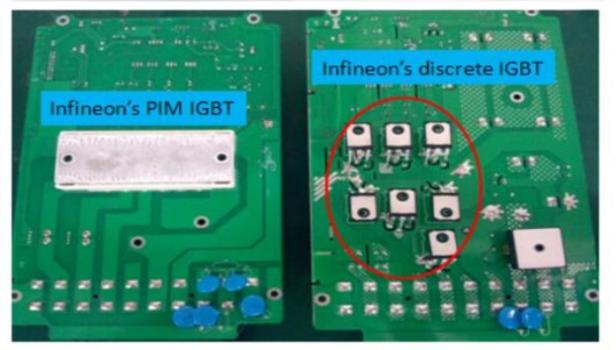
The IGBT tube (commonly referred to as an IGBT single chip) and the IGBT module differ significantly in multiple aspects, primarily in their structure, application characteristics, design flexibility, and performance. The following elaborates on these differences:
1. Structural Differences
- IGBT tube (IGBT single chip):
- Primarily consists of a single IGBT chip and a FWD (freewheeling diode) chip.
- Typically adopts smaller packaging forms such as TO-247, TO-220, etc.
- IGBT module:
- Composed of multiple IGBT chips and FWD chips, as well as driver circuits and other components, arranged in a specific circuit configuration and packaged on a metal substrate as a modular semiconductor product.
- Utilizes larger module packages like Econopack, Primepack, or Intelligipak to support high-power applications.
2. Application Characteristics
- IGBT tube (IGBT single chip):
- Primarily used in low-power, single-chip series or parallel power electronic systems.
- Suitable for low-power applications such as household appliances, power supplies, and motor control.
- IGBT module:
- Primarily used in larger-power, multi-chip series or parallel power electronic systems.
- Ideal for high-power applications including power electronics, industrial automation, transportation, and wind power generation.
- For example, IGBT modules can be used in electric vehicle drive systems for efficient, reliable, and energy-saving electric vehicle control.
3. Design Flexibility
- IGBT tube (IGBT single chip):
- Offers higher design flexibility, allowing for customization based on specific application requirements, facilitating agile design adjustments.
- IGBT module:
- Has relatively lower design flexibility due to its fixed circuit configuration and packaging structure. However, the modular design simplifies the design process and shortens development time.
4. Performance Differences
- IGBT tube (IGBT single chip):
- Typically exhibits lower on-resistance and switching speeds, suitable for low-power applications.
- Current handling capability is generally below several tens of amperes.
- IGBT module:
- Offers higher power density and may have higher on-resistance, suitable for high-power applications.
- Capable of handling higher currents, up to hundreds of amperes.
- Features better thermal conductivity and enhanced heat dissipation due to larger packaging that can accommodate more heat sinks and fins.
In summary, the IGBT tube and IGBT module differ significantly in their structure, application characteristics, design flexibility, and performance. The choice between the two types of IGBTs depends on specific application requirements and system design considerations, including power, current, voltage, heat dissipation, packaging, and cost.
Exploring the Source of Power and the Mysteries of Future Magnetism
AC IM and PMSM Main Differences
SEND MESSAGE